
Are Home Elevators Safe? Myths vs Reality
Table of Contents
ToggleAre Home Elevators Safe? Myths vs Reality
Are Home Elevators Safe? If you’ve ever asked this question, you’re not alone. Thousands of Indian homeowners are exploring home elevators as villas, duplex houses, and G+1 or G+2 homes become more common across cities like Hyderabad, Bangalore, Mumbai, and Delhi.
But here’s the surprising part:
👉 According to global lift safety studies, modern residential elevators have multiple redundant safety systems—often more than many everyday household appliances.
👉 In India, elevators must comply with strict state lift acts and national safety standards.
👉 The majority of elevator accidents reported in India involve commercial buildings, not properly installed residential lifts.
Yet, fear persists.
Are home elevators safe for children?
Are home elevators safe for elderly parents?
Can a lift fall if power fails?
Is it risky in Indian power conditions?
Let’s break down the myths vs reality so you can make a confident, informed decision.
Are Home Elevators Safe? Understanding the Basics
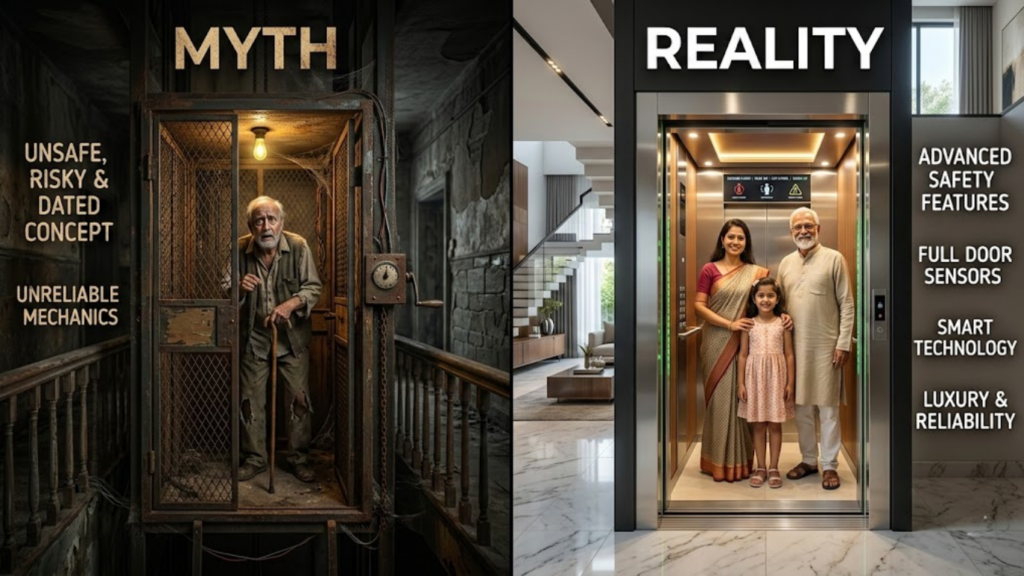
Before we address the myths, let’s understand how a modern home elevator works.
Residential lifts today are engineered with:
Automatic door interlocks
Emergency alarm systems
Overload sensors
Emergency battery backup
Automatic rescue device (ARD)
Overspeed governors
Safety brakes
Infrared door sensors
Unlike old industrial elevators, modern home lifts are designed for low speed, short travel distance, and controlled usage—making them inherently safer in residential settings.
So when someone asks, Are home elevators safe? — the real answer depends on installation quality, safety standards, and maintenance.
Myth 1: “Home Elevators Can Suddenly Fall”
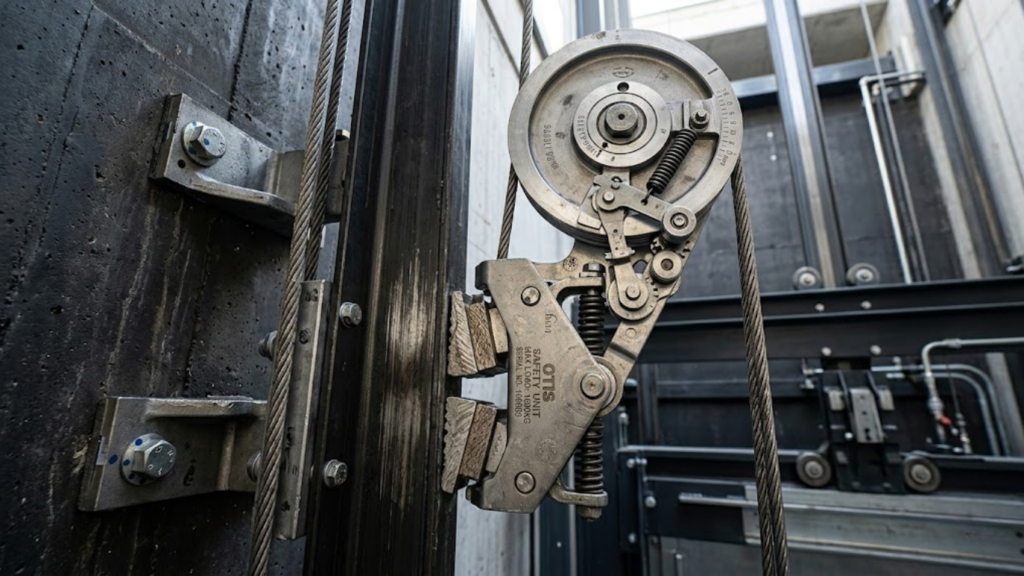
Reality: Free-fall is extremely rare due to multiple braking systems.
This is one of the biggest fears in India. Many imagine a dramatic movie-style lift crash.
Here’s the truth:
Modern home elevators use:
Steel hoisting cables rated far above required load
Overspeed governors
Automatic safety brakes
Mechanical locking systems
If the lift moves faster than its rated speed, the governor triggers brakes that clamp onto guide rails.
In fact, statistically, elevator free-fall incidents are exceptionally rare worldwide.
When installed correctly, the answer to Are home elevators safe from falling? is overwhelmingly yes.
Myth 2: “Power Cuts Make Home Elevators Dangerous in India”

Reality: Battery backup systems prevent entrapment.
Power cuts are common in many Indian cities. So it’s natural to wonder: Are home elevators safe during electricity failure?
Modern residential elevators include:
Automatic Rescue Device (ARD)
Battery-operated emergency lowering system
Cabin light backup
Alarm button
When power fails, the lift automatically moves to the nearest floor and opens the door.
You are not stuck inside for hours.
In fact, many home elevators are safer during power outages than some household electrical appliances.
Myth 3: “Home Elevators Are Unsafe for Children”

Reality: Child safety features are built into modern designs.
Parents often ask, Are home elevators safe for kids?
Modern lifts include:
Infrared curtain sensors
Door obstruction sensors
Soft start & stop mechanism
Automatic door locking
Unlike staircases, elevators reduce the risk of falls—one of the most common household injuries in India.
According to global injury data, staircase falls cause significantly more injuries than residential elevators.
So in many cases, a home elevator may increase safety for children rather than reduce it.
Myth 4: “Home Elevators Are Risky for Elderly Parents”
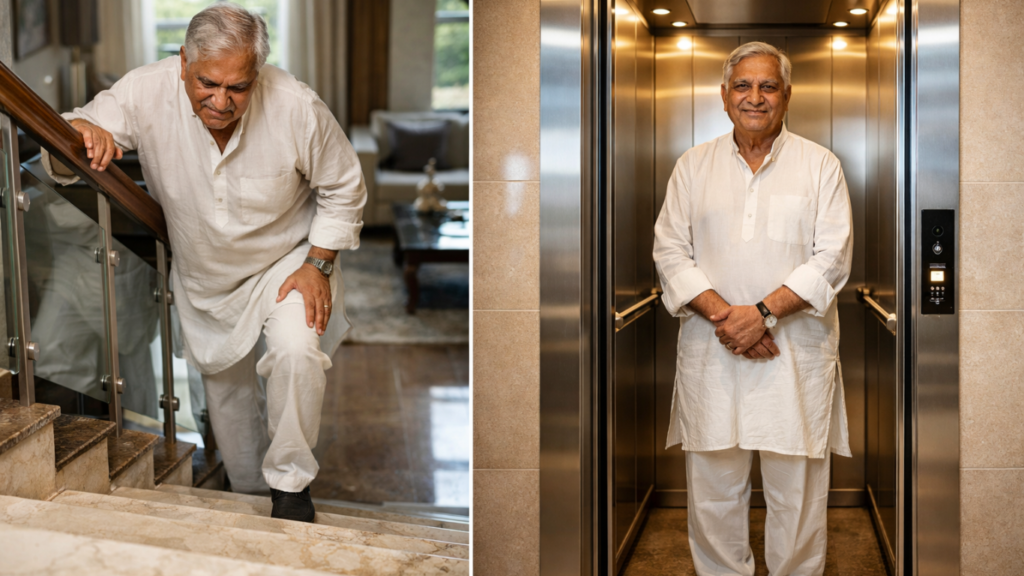
Reality: They significantly reduce fall risk.
India has a growing elderly population. Climbing stairs daily increases:
Knee stress
Joint pain
Fall risk
Fatigue
So when evaluating Are home elevators safe for senior citizens?
The better question might be:
Are stairs safe long term for elderly parents?
With handrails, non-slip flooring, and smooth movement, elevators offer controlled and safe vertical mobility.
Myth 5: “Home Elevators Need Huge Space & Compromise Safety”
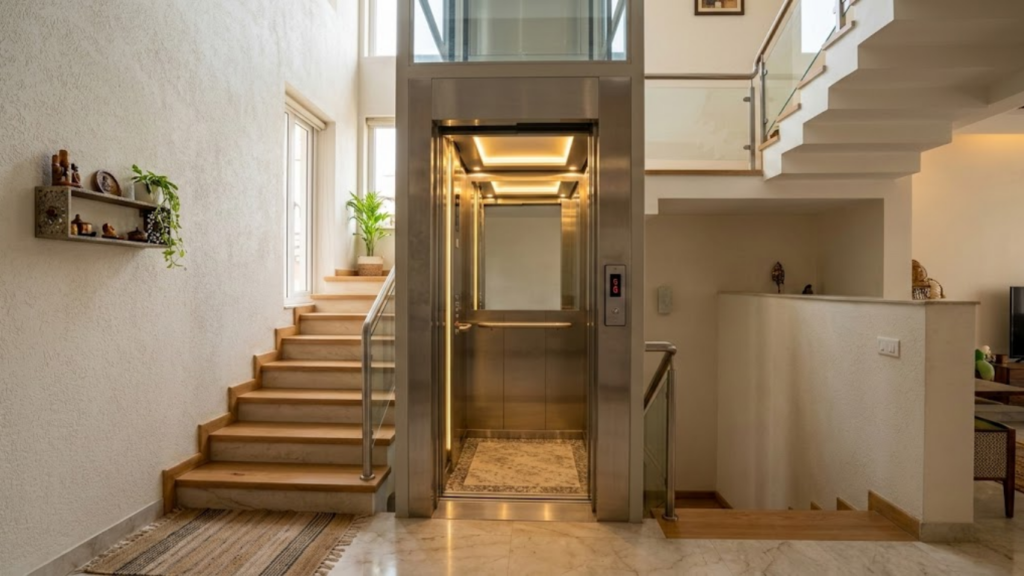
Reality: Modern compact lifts are engineered for homes.
Old commercial lifts required deep pits and large shafts.
Today’s residential lifts can:
Work without a deep pit
Operate without a machine room
Fit in small shaft spaces
Be installed in existing homes
Safety is not compromised because the engineering is adapted for residential needs.
Are Home Elevators Safe? Indian Standards & Regulations
In India, elevator installation is governed by:
Electrical safety regulations
Local municipal approvals
Installers must follow:
Structural load calculations
Electrical earthing standards
Emergency safety integration
Periodic inspection compliance
When installed under proper licensing and compliance, home elevators meet strict regulatory frameworks.
Key Safety Features in Modern Indian Home Elevators
Let’s break down the safety layers:
1. Door Interlock System
Prevents movement unless doors are fully closed.
2. Emergency Alarm & Intercom
Allows communication in rare emergencies.
3. Automatic Rescue Device (ARD)
Moves lift to nearest floor during power failure.
4. Overload Sensor
Prevents operation beyond weight capacity.
5. Overspeed Governor
Stops the lift if speed exceeds safe limit.
6. Safety Brakes
Engages instantly during abnormal movement.
7. Manual Lowering Option
For technician rescue if needed.
These multiple redundancies answer the question clearly:
Are home elevators safe? Yes — when built with certified systems.
Real Risk: Poor Installation & No Maintenance
Here’s the uncomfortable truth.
Most elevator issues in India happen because of:
Unlicensed installers
Substandard materials
Lack of maintenance
Ignoring safety checks
So instead of asking only Are home elevators safe?, ask:
Is the company licensed?
Are safety certifications provided?
Is AMC (Annual Maintenance Contract) included?
Are technicians trained?
Safety depends more on provider quality than the technology itself.
Home Elevators vs Stairs: Which Is Safer?
Let’s compare:
| Risk Factor | Stairs | Home Elevator |
|---|---|---|
| Fall Risk | High | Very Low |
| Elderly Safety | Low | High |
| Child Safety | Moderate Risk | High |
| Power Dependency | No | Yes (with backup) |
| Daily Strain | High | Minimal |
In multi-storey homes, elevators often improve overall safety.
Psychological Fear vs Engineering Reality
Many fears about elevators come from:
Movie scenes
Viral accident videos
Outdated technology stories
But modern engineering has evolved significantly.
When properly installed, the real-world data supports the conclusion that residential elevators are among the safest mechanical systems in homes.
Are Home Elevators Safe for Indian Villas & Duplex Homes?
Absolutely — especially in:
G+1 homes
G+2 houses
Luxury villas
Independent bungalows
Retirement homes
In India’s hot climate, avoiding daily stair strain also improves long-term health comfort.
How to Ensure Maximum Safety
Follow this checklist:
✔ Choose a licensed elevator provider
✔ Verify BIS compliance
✔ Ensure ARD & battery backup
✔ Schedule regular maintenance
✔ Install CCTV (optional)
✔ Educate family on safe usage
✔ Avoid overloading
Safety is not just technology — it’s responsible ownership.
F.A.Q.
Frequently Asked Questions
Modern lifts include safety brakes and stop mechanisms. Structural compliance is crucial in seismic zones.
No mechanical system is safe without periodic inspection.
Yes, with annual maintenance and quality components.
Yes, when supervised and equipped with sensors.
The Final Verdict: Are Home Elevators Safe?
Let’s answer clearly.
Are Home Elevators Safe?
Yes — when:
Installed by certified professionals
Equipped with modern safety systems
Maintained regularly
Compliant with Indian regulations
In fact, in many cases, home elevators are safer than stairs for children, elderly parents, and long-term mobility.
Fear comes from outdated assumptions.
Reality comes from engineering, compliance, and responsible installation.
Conclusion: Thinking of Installing a Safe Home Elevator in India?
If you are planning to install a residential lift and want maximum safety, compliance, and long-term reliability, choose a trusted and experienced provider.
AG Elevators specializes in safe, certified, and professionally installed home elevators across India — designed with advanced safety features and long-term maintenance support.
👉 Want to know if a home elevator is right for your house?
Contact AG Elevators today for a free consultation and safety assessment.
Stay Connected With AG Elevators
For more updates, inspiration, new lift models, and installation showcases, follow us on social media:
Stay updated with the latest innovations in home elevators across India!